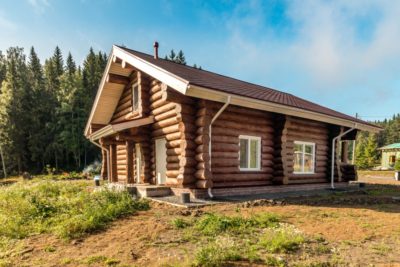


One-Story Log House: Pros and Cons

The number of storeys in your to-be home is an important consideration which must be decided during the construction planning phase. The price of the future log house, its exterior and, even more so, the comfort of living will depend on the area and the number of storeys. In this article we have collected all pros and cons of single-storey log cabins. Advantages A one-story house is cheaper at all stages of construction: less cubic volume of wood, less foundation area, less roofing material and insulation. The construction time is shorter too. A one-storey log house does not have a...
MoreLarge diameter log houses

Log cabins made from large-diameter logs have become very popularity lately. Such houses revoke the original building traditions while also offering durability, environmental friendliness and attractive exterior. The existing construction standard do not have any guidelines for log houses. In practice, builders use logs from 36 cm in diameter. This material requires special knowledge and skills. As a result, we always get an exclusive house with many advantages: Warmth. The larger the diameter of the tree, the lower its thermal conductivity. Log houses are always warm, cozy and...
MoreAdvantages and disadvantages of two-story log houses

If you decided to build a wooden house, it is important to choose not only a logging technology, but also the number of storeys your house will have. Two-story designs are most popular choices for families. They usually have small land plots. But let’s consider all pros and cons of two-storey timber buildings. Advantages A two-story log house is suitable for small sites. It will save the area for other buildings on the site, such as a bathhouse, a garden, barns, or simply a recreation area. Two-storey houses often help save money on building materials and site preparation. A...
MoreExterior arrangement of a wooden home

Once a log house has been cut, its construction does not end – it is time to do exterior and interior finishing. The exterior of a building depends on how well were its functional and decorative elements designed. So, this is something that must be taken into account already during the design phase. Recommendations: Unlike frame houses, the facade of log houses does not need cladding as logs are an excellent decoration material that has high thermal conductivity and strength. After the construction is completed, it is important to apply wood protection and impregnation (to protect...
MoreFlooring on round interfloor beams

The floor beam is not only a support for the flooring, but also an element for strengthening the entire structure of the building and giving it rigidity. They bear a large load of the second floor, the attic. That is why it is important to competently approach the choice of the material and the installation of beams. Ceiling beams with a diameter of 30-32 cm are inserted into the bearing walls thereby increasing the stability of the structure. Installation is usually carried out with dovetail joints, fastening two parallel walls together. Most often, they are placed with an interval...
MoreShrinkage of the log house

The shrinkage of a wooden house is a natural process that occurs as a result of drying of the wood and compaction of the insulation. This leads to a decrease in the linear size of the structural elements and the appearance of small cracks during drying. Shrinkage is calculated based on the type of logs and the material used, and on average it makes 8 percent of the total wall height. During the first year, the shrinking process is most active. It is not recommended to install and run any heating sources during this period, such as a fireplace and underfloor heating. Beginning from the...
MoreHeating in a wooden house

A log house requires a properly installed heating system that determines whether the premises will be warm, the house’s service life will be long and the logs’ appearance will be preserved. Wooden structures can save money on heating due to the thermal mass of the logs – they are able to absorb light and heat, emitting energy as they cool. Moreover, wood can regulate the temperature due to its natural mechanism of ventilation. Heat accumulation properties can also be improved artificially – for this, you need to better site your home and windows in relation to the cardinal...
MoreCasing

The casing, or enclosing frame, is a special wooden frame that helps reduce pressure on windows and doors during the shrinkage of a log building and maintain its geometry. Due to its design, this element can be moved a little, reducing the negative impact on the windows in the process of the house shrinking. Specifics: The casing is mounted to the ledger inserted into the opening. This ensures sliding that protects the box from the shrinkage effects. To calculate the casing height, it is recommended to subtract about 8 percent from the opening’s height. The upper gap is filled with a...
MoreInstalling rafters

The rafter system is the basis of the roof of a log house. The quality, safety and durability of the roofing largely depend on how well its assembly and installation were done. The design of the rafter system always begins with the choice of the type of roof: attic or cold attic. The elements of the rafter system are connected with struts, braces and diagonal joints. They are needed to increase rigidity and for safety. Rafters are especially susceptible to shrinkage, therefore, sliding supports are used to compensate for this. An open slide is a special L-shape fastener with a loop and...
MoreInstalling a log house on the foundation

Installation of the log house is the next step once the foundation and walls are ready. The basement set depends on the type of a house and the rigidity of its foundation. Each log is then stacked sequentially according to the design. The Canadian method implies the absence of any gaps between the logs, which is achieved by the tight fit, trapezoid grooving and putting the insulation into the internal channel. All corner joints are adjusted to the nearest millimeter, which ensures not only a beautiful appearance, but also the correct geometry of the log house. Such installation...
More